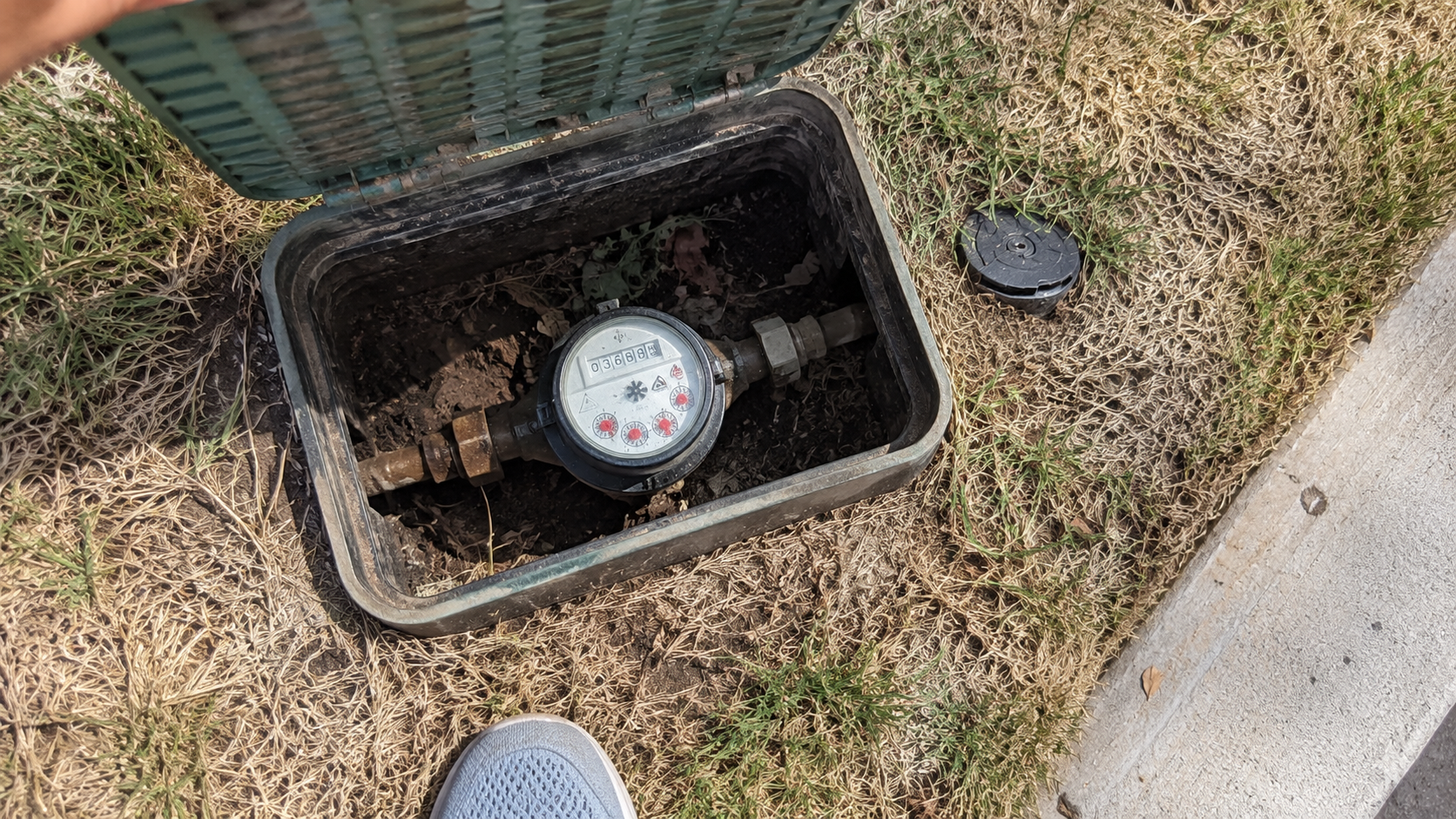
Your water bill doubled. Your habits didn't change. You walk the house and everything looks fine — no puddles, no drips, no obvious problem.
That's the frustrating part about hidden leaks. The water is going somewhere. You just can't see where.
Here's how to track it down: a test you can run yourself, the usual suspects in North Texas homes, and the point where it's time to stop guessing and call someone with the right equipment.
Before anything else, confirm you actually have a leak. This takes about an hour and costs nothing.
If the meter held perfectly still, your high bill is probably about usage, not a leak. (Summer irrigation and house guests are the two big ones in North Texas.)
If the meter test points to a leak, here's where it usually hides — roughly in the order we find them.
A toilet with a worn flapper can quietly leak hundreds of gallons a day and never make a sound. The dye test above takes two minutes. If the color seeps into the bowl, that's your leak, and a flapper is a few dollars at the hardware store. Always rule this one out first.
This is the big one in our area. An underground sprinkler or main line can leak for weeks before you see a single wet spot on the surface — the water just sinks into our clay soil. Watch for a patch of grass that's greener or spongier than the rest, or heads that come up weak. A surprise summer bill spike in North Texas is an irrigation leak more often than not.
If the toilet's fine and the irrigation checks out, the leak is likely in a pressurized line you can't get to — under the slab or in the service line between your meter and the house. These don't announce themselves. The clues are subtle: a warm spot on the floor, the faint sound of running water with everything off, water pressure that's dropped across the whole house.
This is where DIY ends. You can't dig up a slab or a yard on a hunch. The line has to be pinpointed first.
Call for professional detection when:
That last one is the important one. The most expensive mistake we see is a homeowner — or a handyman — opening up concrete or trenching a yard in the wrong spot. Pinpointing the leak first is what keeps the repair small.
We don't dig to go looking, and we don't guess. We use professional-grade LeakTronics acoustic equipment to hear water moving through the line — even under a slab or buried in the yard — and thermal imaging to confirm the spot. A leak only makes noise when water is actively flowing, so we listen for that flow and trace it to the source.
Most inspections across Tarrant and Johnson County wrap up in a single visit, usually inside two hours. You leave with the exact location marked and clear documentation your licensed plumber can act on right away.
Most residential leak inspections in our area run between $300 and $650, depending on the size of the home and the complexity of the leak. You get a flat estimate before we start — no hourly surprises.
Put that against the leak itself: a hidden line running 24/7 can add hundreds of dollars to your bills over a few months, never mind the damage. Finding it fast is the cheap move.
How do I know if my high water bill is a leak or just usage?
Run the meter test. Shut off all water for one to two hours and watch the meter. If it moves, it's a leak. If it holds still, the bill is about usage — usually summer irrigation or extra people in the house.
What's the most common hidden leak?
A running toilet, by a wide margin. Always run the dye test on your toilets first; it's free and it's the cheapest fix. After that, irrigation lines are the most common in North Texas.
Can you find a leak underground in my yard?
Yes. Irrigation and service-line leaks are some of our most common calls. We locate them with acoustic equipment, no digging required, and mark the exact spot.
How quickly can you come out?
Same-week scheduling is the norm across Tarrant and Johnson County, and same-day is sometimes possible. If water is actively flooding, call and we'll be straight with you about timing.
Do you fix the leak?
No — RGC does detection and documentation only. Your licensed plumber handles the repair. We find it, mark it, and document it so the repair is fast and precise.
Tell us what you're seeing — the bill, the meter reading, a wet spot in the yard. Five-minute call, flat estimate, same-week scheduling across Tarrant, Johnson County, and the surrounding areas.
Call 817-406-1567 for a free estimate.
Tell us what you're seeing. Five-minute call, flat estimate, same-week scheduling. If RGC isn't the right fit, Ralph will tell you straight.
Voicemail? Ralph calls back the same day.
Tell us what you're seeing. We'll text or call back within the hour.